On Two Revolutions – Public History in the Bicentennial Era

In years surrounding the Bicentennial of the signing of the Declaration of Independence and the Revolutionary War, public history underwent a revolution of its own. Planners had hoped to stoke the flames of patriotism with a large, unified Bicentennial celebration. They instead watched as the national celebration splintered into smaller localized commemorations and the state-approved narrative of American excellence and exceptionalism began to crumble.

For in the 1970s, the general public began to see their history in new ways. They longed to ditch the Great Man theory of history and instead look at the past through multiple, diverse lenses. A lot of this shift had to do with the politics of the era – the grassroots movements that rejected the story of America as only the white man’s story and the growing level of mistrust of the government after the lies of the Vietnam War and the corruption of the Nixon administration being two prime examples.

History-tellers of all kinds, both academic and non-traditional, rose to meet the demands of the time. They recognized the power of history to build identity, especially in marginalized groups, and raise political consciousness. They jumped at the chance to make history more relevant to contemporary events by keeping the past in conversation with the present. They heeded the call to experiment with affective engagement, leaning into the ability of emotional responses to make history come alive.

In History Comes Alive: Public History and Popular Culture in the 1970s, author M. J. Rymsza-Pawlowska dives into the transformation of public history during the Bicentennial era from activism on the ground to pushback in the seats of power. M. J. Rymsza-Pawlowska examines this pivotal moment in how we looked back on our 200 years as a country across the spectrum of culture and collective memory practices, from television shows to archives and museums and even historically conscious forms of protest.

Each chapter is chock full of fascinating practices and events that I could probably fill out a ten-page paper on the subject nicely. For the sake of keeping this blog post readable, I’m going to focus in on a chapter I found particularly interesting, namely the chapter on innovative museum practices that evolved in the 1970s.

Creating relevant, engaging exhibits is something I constantly strive for and a goal I consider at every step of the exhibit development process. As I work on a permanent, core exhibit that could very well be open to the public for the next 15, even 20 years, it is somewhat frightening to think that what might be considered cutting edge today, could soon be outdated and even cheesy.

Looking back on Boston’s “The Revolution” exhibit nearly 50 years later, I couldn’t help but cringe a little. As a disclaimer – I think their intentions in creating the exhibit were very noble. They wanted to connect the past to the present in a meaningful way. But presenting fake news footage of the Boston Massacre? It reminded me of some of the cheesiest videos I watched in my elementary school classes. You know, the ones the sub would pop into the VCR player featuring well-meaning adults trying way too hard to connect with “the youth”?

I personally believe a certain amount of subtlety is crucial to drawing connections between the past and the present. From my experience, visitors prefer to discover these links to the past on their own (with just a little bit of guidance), not be hit over the head with the fact.

To be fair to the developers of this exhibit, they were creating their exhibit for a specific time period – Bicentennial era – and under a certain set of constraints (pressure to be more celebratory than critical, attitudes of the time, etc.) Ultimately, I think they succeeded in pushing the boundaries of what could be done in an exhibit. Overall, the 70s encouraged museum professionals to think outside of the curiosity cabinet and beyond the supremacy of the historical artifact. The push toward experiential learning opened up a whole new creative realm for exhibit designers and paved the way for exhibits that encourage visitors to think of history not as an inevitable progressive path but rather as the complicated result of complex choices.
Between the Past and the Present: Landsberg’s Theory of Affective Engagement

People want to feel close to the past. Traditional, academic history keeps their audience at an arm’s length, talking about the past as cold, distant, and foreign. It’s no wonder then that so many balk at learning history, especially the history that many people have been taught growing up – predominately the stories of rich, male WASPs. Instead, most people engage with history through popular media like movies, TV shows, and online resources.

In her book Engaging the Past: Mass Culture and the Production of Historical Knowledge, Alison Landsberg argues that scholars should take the historical work being undertaken outside of the confines of the ivory tower more seriously and acknowledge popular media’s capability to foster historical thinking, build historical knowledge AND engage a larger audience.

Historians know the importance of placing oneself in the shoes of a historical figure, considering the alternative courses of action and the confines of experience built up by the context of the time. This practice helps shake us out of the false notion that the events of history were inevitable, meant to be.

Popular media helps bring this mindset to the broader public. Audio-visual formats engage not just sight and sound, but all the senses. We physically recoil hearing screams of pain and feel the tension of a suspenseful moment in our bodies. We even imagine the stench of dung-laden city streets or a military field hospital and the taste of elaborate meals set out before kings.

Through a movie, TV show, or even an exhibit (physical or virtual), we feel almost like we have stepped into a completely different historical moment. Viewers get a better sense of the justifications for why certain decisions were made, why people lived the way they lived, and why we are where we are now.

This phenomenon, that touches the emotions and guides viewers to create their own personal meaning out of history, is called affective engagement. Landsberg pinpoints affective engagement as the reason why popular media formats are so effective at engaging audiences with the past, giving them a personal stake in history, and even stoking political consciousness.

The most successful of these popular endeavors do not allow the viewer to seamlessly slip into the past. Instead, they hammer in the point that all history is mediated – narrated and passed down by biased sources. We can never relive the past. This moment of cognitive dissonance when we mentally flit back and forth between past and present is when we start thinking historically and build historical knowledge.

Throughout her book, Landsberg illustrates her theory by citing examples of films, television shows, and online exhibits that masterfully utilize affective engagement to foment historical consciousness.

Milk brings the previously little-known story of a gay politician to the forefront of the public consciousness, and mediates the story through Harvey Milk’s own words, days before his assassination. Unlike many other films that came before it, it also serves to humanize LGBTQ Americans, treating their stories as worthwhile, rather than treating them as the butt of a joke or, worse, a sinful abomination. This film shone a bright light on the LGBTQ+ rights movement, which had not been covered seriously and respectfully in the public sphere.

Television shows take affective engagement a step further, as their serial format can point out historical inconsistencies and change over time and tend to avoid a teleological narrative that wraps the events of history up in a tight bow. Even with lush, seductive recreations of a time period, like in Mad Men, historically conscious dramas are rife with moments that pull the audience out of the reverie and make them contend with modern day issues that have roots in the past and shatter historical myths.

In Mad Men, the causal racism spewed so easily by the show’s main characters jars viewers and makes them understand the racism of the time better. African Americans get little thought from people like Don and Betty Draper, except when Don is trying to sell them something or Betty’s domestic servant puts dinner on the table for her kids. I remember being taught in school that scenes of the brutal crackdown on the Civil Rights movement galvanized people in the North to support the end of segregation. However, Mad Men shows that people like the Drapers didn’t think it was any of their business – it was a Black problem, a problem for Southerners.


Museums also use affective engagement as a tool to bring their visitors closer to history, to help them making meaning out of our shared past. From the dawn of the digital age, museums have made efforts to transfer the museum experience online, creating new avenues of engagement. This is even more relevant today, in the midst of the COVID-19 pandemic. The examples Landsberg gives – the Anne Frank House’s Secret Annex Online and the US Holocaust Museum’s Kristallnacht experience on Second Life – are incredible examples of how museums can create entirely new experiences online and reach broader audiences.

I’ll end with this quote from a visitor to the exhibit on Second Life –

“I was at the DC Holocaust Museum last year, and hate to say – the noise and crowds somewhat diminished the powerful of this for me. But this, at my own pace, in my own space – wow.”

pg. 173

This quote to me shows the promise of online exhibitions and the power of affective engagement.

We can’t expect every visitor or audience member to learn and engage in the same way. Offering up different experiences for different learners is the best way we can invite people into what we have to offer so that they can learn from history and make their own meanings that they can take forward with them.

(Re)introducing Me –

HIST 6001 – Introduction to Public History

My name is Lindsay and a lot has changed since I introduced myself ahead of a course way back in January 2020. We’ve been plunged into the world of the uncertain, the unknown, the unprecedented. Every facet of life looks a little bit different than it did before – classes are (mostly) online, work is done from my desk that is (hopefully) temporarily in my living room. These times even have me looking at my career trajectory differently. Opportunities seem a bit narrower, competition seems a lot tougher. I still have a full year between me and the full time job market, but I have not escaped the pandemic unscathed. A paid summer internship, the rarest of creatures, vanished before my eyes back in May.

Despite the fears and challenges of the last few months, I haven’t let COVID-19 beat me down. I’m excited and ready to jump into my second and final year as a graduate student (God forbid I talk myself into a PhD) and expand my historical and museological horizons. My phenomenal, ever-rewarding assistantship experience carried straight through the summer, thankfully, otherwise I’d be writing about missing it! It feels incredible to play an active role in conceptualizing and redesigning core exhibits on St. Louis history, sitting at the table with public historians and designers who consistently put out engaging, innovative work, and be treated as a valuable member of the team.

All this to say, all things considered, I am optimistic about the year ahead. I’m looking forward to meeting the members of the new cohort. Hopefully we can grab a socially distant coffee/tea/water/other beverage at some point! Please don’t be afraid to reach out.

Looking forward to this semester’s conversations!

Looking Back and Looking Forward

This semester is not what anyone thought it would be.

Now, somewhere around week eight or nine of being confined to our homes, the importance of digital public history is immensely clear. With museums, libraries, and universities closed, it’s all we have.

Throughout this course, we’ve looked at unique ways to engage with the audience in various digital media – online deep maps, digital exhibits, interactive digital elements in physical spaces, etc. If I had to guess, as we go forward, these digital components will become more and more central to the work of cultural institutions. Because who knows when we’ll have to shut down the doors and do quarantine all over again.

This course has taught me that I have so much more to learn. To make meaningful contributions to digital efforts in my career, I’ll have to get my feet wet with different mapping tools, website builders, and other things I probably don’t even know the proper terms for. From here on out, I’ll be making a concentrated effort to keep up with what museums are trying so I can use them for inspiration later in life.

Looking forward, it’s hard to imagine how the museum experience is going to change once the world reopens. It seems like I’ve scrolled past hundreds of posts, full of conjecture. Some foretell doom – it’s the end of museums as we know it. Some proclaim that all will go back to normal, eventually. It’s nearly impossible to say which is the case.

Will people stay away in fear or will people flood cultural institutions, hungry for any kind of outside entertainment? Close to my house, huge crowds swarmed the streets as bars and restaurants illegally reopened. People went wild. Some even sold booze on the street. There was not a mask to be seen. So, this anecdotal example, paired with state house protests, shows one possible future. Some people may care for their own entertainment, their own “liberation,” over the safety of others.

If this truly is the case, museums are going to have to tread a difficult balance between protecting visitors and looking to make money again. The longer this goes on, the harder museums are going to have to fight to stay alive. Opening up, for many museums, means bringing in ticket revenue again. But, it could also play into a second wave of the virus. The next few weeks will bring some difficult decisions for museum administrations across the country.

Like many of my colleagues, I’m excited to walk back into a museum again. I’m excited to be able to work anywhere but my dining room table. I want to see my friends and walk around in public without fear. Sometimes it feels like it’s been months since life was normal, sometimes it feels like time has passed by incredibly fast. All of us want to go back to normal, no one knows what “normal” is going to look like after this. It’s hard to draw a conclusion to this, because so much is up in the air.

As public-facing historians, dipping our toes in the digital realm, perhaps there was no better time for this class to take place. Even though the course changed dramatically, we got the opportunity to think critically about digital engagement in a time where the stories, collections, and programming of museums only exist online. We’re living in interesting times. Let’s hope they make us more effective museum professionals.

The Exhibit Developer’s Bible

This week, I was lucky enough to spend time revisiting a book that holds a place of honor on my shelf, the second edition of Exhibit Labels: An Interpretive Approach by Beverly Serrell. I first picked it up for a class reading in undergrad. Since then, I’ve occasionally flipped through on a quest to find the handy-dandy interpretative labels chart and feel my heart sink when I see how few words I should aim for in an introductory, group, or caption label.

Reading through three of its chapters again, I definitely understand why many museum professionals call it “the Bible.” It is a treasure trove of a resource, pulling together personal experience, visitor studies research, and examples from museums of every kind, including even roadside panels like the ones I, without fail, made my parents stop at on road trips during my childhood.

Serrell’s exhibit development and label writing tips and tricks seem even more relevant to me now as I am working on building an exhibit for my practicum class (through the University of Missouri – St. Louis’s museum studies program) at the National Blues Museum in Downtown St. Louis. Usually, the class consists of a team of at least 10, but this semester it is only four other women from my cohort and I tackling the stories of traveling blues musicians in one relatively small exhibit space.

Collectively, we experienced the challenges of creating a big idea that, in Serrell’s words, is “owned” by every stakeholder, including those outside of the immediate team. In our case, we also had to bring the museum’s interim director and our advisory team, members of the local blues community, on board. Like Serrell advocates, our big idea development process was evolutionary, not static. It changed as our priorities changed, as we came across new information and considered the topic from different angles.

In her chapter on interpretative labels, Serrell quotes from Lisa Cron’s work Wired for Story: The Writers’s Guide to Using Brain Science to Hook Readers from the Very First Sentence:

“All story is emotion based – if we’re not feeling, we’re not reading.”

In Exhibit Labels on page 23

From the beginning, our advisory board stressed the importance of telling an emotional story, because their experience of the Blues and of travel during the Jim Crow era was fundamentally emotional. In the exhibit, we’re talking about the experiences of black travelers in general through the individual stories of different musicians. If a history museum’s job is to make history come to life, emotion rests at the cornerstone of that effort.

I particularly loved Serrell’s call to “let your labels be jumping-off places for people’s imaginations. Let them fill in many more words and feelings” (26). As much as it often pains me to cut out text that I’ve written, this quote serves as a reminder that I shouldn’t get in the visitors way. Sometimes, emotion comes from what is left unsaid – what the visitor creates in their mental picture.

Re-reading this excerpt from my personal Bible could not have been more timely as this week, I am working on finalizing all of the practicum exhibit’s text. Serrell implores us, as label-writers and exhibit developers, to keep the rich diversity of audiences that walk through a museum at the forefront of our minds. We write to enhance their experience , to facilitate their learning and spark curiosity, not to make ourselves look clever or cast ourselves as experts.

With this task ahead of me, I look forward to flipping through Serrell’s text as I go, making difficult cuts and sharpening language. Hopefully, we’ll end up with an exhibit that would make her proud, and more importantly, engages and excites visitors.

The Short Lifespan of Digital Elements in Museum Spaces

Museums in the Digital Age: Changing Meanings of Place, Community, and Culture by Susana Smith Bautista asks as a series of case studies, taking the temperature of digital initiatives in five art museums around the country: the Indianapolis Museum of Art in Indianapolis, Indiana; the Walker Art Center in Minneapolis, Minnesota; the San Francisco Museum of Modern Art in San Francisco, California; the Museum of Modern Art in New York City, New York; and the Brooklyn Museum in Brooklyn, New York.

Today, for the sake of brevity, we’ll be discussing the first three examples.

Unfortunately, I found in my reading that many of the digital projects have already disappeared from the internet entirely, replaced by new or different enterprises. This is remarkable, considering that the book was only published in 2013. Only six years have passed and yet the digital world looks entirely different. Instagram isn’t mentioned once! This serves as a timely reminder of how fast technology moves, how quickly the digital world can change.

Still, it it important to remember that new does not always mean better. As historians, we should know – it’s important to look back at the past for ideas. Some of the ideas from the digital past still hold weight. Just because they are not in practice in their home institutions anymore doesn’t mean that they wouldn’t fit nicely into another institution’s website or find themselves just at home in a museum gallery.

The digital projects of the Indianapolis Museum of Art serve as a fantastic example. For instance, at the time the book was written, their web address was iam.org. Since then, the museum has undergone a bit of a brand redesign. It’s new name and web address reflected its location among over 100 acres, alongside other institutions: Newfields and discovernewfields.org. The digital projects touted in Museums in the Digital Age are now no more. However, several are tantalizing and inspiring.

Two prime examples are the tag tours and the “first impressions” feature. Digital collections are searchable because they are tagged with things like “Renaissance,” “Impressionism,” etc. The Indianapolis Art Museum invited guests to supplement tags on works by suggesting new tags. From there, museum staff curated “tag tours” that would guide visitors through somehow related art works. Refreshingly, these tours did not take themselves too seriously. Art museums are are usually critiqued for being stuffy and self-important. The titles of these tag tours disprove this critique. They include “In the Nude,” “LOL Catz,” and “Impress My Boss/Grandma/Hot Date.” Tag tours allow visitors to encounter and interact with the collections in a casual, fun way. “First Impressions” was equally fun. When looking at a piece of art online, visitors were encouraged to click on the thing they noticed first. Afterwards, they could see what other online visitors clicked on, comparing the density of clicks in red to their click in green. I only wish they were still live so I could go through them.

Another fascinating project took place at the Walker Art Center. Called 50/50: Audience and Experts Curate the Paper Collection. Visitors were encouraged to vote on the pieces they wanted included in the exhibit, without the influence of curator comments via labels. The digital component came in in the voting stations, which took place on kiosks placed around the museum space. As the name implies, half of the gallery space went to the choices of the guests, arranged in order of the votes, and the other half was traditionally curated.

All the museums stress the importance of opening the museum up to a global audience, beyond the local community and the institution’s four walls. However, the San Francisco Museum of Modern Art seems to have put the least stock into digital projects. In fact, its digitally-equipped physical spaces were treated as a bit of an afterthought, only to be included if they have a space they don’t know what to do with. Called Learning Lounges, they are a place behind a closed door, separating the “sacred” gallery space from more innovative digital spaces.

Though you can’t find some of these digital initiatives online or on the gallery floor anymore, they still provide lessons to learn from and ideas to “steal” moving forward.

Planting Seeds in Unknown Soil – NCPH in the Time of COVID-19

If all was normal in the world, I would have spent the better part of the last week in Atlanta attending the National Council on Public Conference, taking in local museums and historical sites, and learning more about the craft of public history from amazing professionals from across the country. Instead, we as a nation (for the most part) are staying at home and helping to flatten the curve, reduce the number of cases, and staying within our health care professionals’ capacities. My plans have shifted entirely, and now I’m facing the decision to ride it out in Ohio with my family or return to my apartment in St. Louis.

These are unprecedented measures in modern America and NCPH had to take unprecedented steps in canceling the in-person conference and transitioning to virtual meetings. Unfortunately, I missed the vast majority of the NCPH programming as I helped my little brother move out of his college dorm and I packed up enough of my life to last for as little as spring break or as much as several months. My poor cat also has been uprooted and is now forced to live with three large, slobbery dogs.

Luckily, I was still able to find and listen to the Presidential Address, given by outgoing NCPH president Marla Miller. For the first time in NCPH’s history, this address was given in podcast form, rather than from a podium. In a time where we are so focused on the present moment, Miller gives us a reminder to look to the long arc of history and the long arc of our impact on our audiences in our work as public historians and museum professionals.

Evaluation is a necessary part of any public facing project. Donors, investors, and board members rely on metrics to show that their input and investment has been put to good use and has made an impact in the community. However, their is no good or cost-effective way to measure long term impacts on visitors/the public’s life after they come in contact with a museum or other public history project.However, these are the deepest impacts. As Miller says, “public history is a long game.”

Anecdotally, we know that individual exhibits, documents, and artifacts can inspire people to go into history or just simply stick with people through their lives. For me, it was an exhibit at the Missouri History Museum, created by my now supervisor Andrew Wanko, called “A Walk in 1875 St. Louis.” I loved the attention to detail and the focus on the everyday lives of everyday St. Louisans. I was a freshman in college when that exhibit opened and it reinforced my desire to work in the museum field. I wanted to make exhibits like that.

Miller says that these seeds are much like the seeds of the white pine, which can survive underground for decades and in the meantime interact with other seeds to create new life. Our work, our seeds, interact with the public’s experiences and create an impact in their lives. Though the impacts of our work is often invisible or untraceable, our work is not unimportant. Miller advises us to look for seeds for ours to interact with, issues of common concern that can take root together.

In this present time of uncertainty, we must keep our eye on the future. Our efforts in bringing stories to the public now may plant seeds into the future. When we can’t track visitors coming through the doors, we can still make an impact on our community. We’re living in interesting times and it’s up to us to come up with innovative solutions to plant those seeds and get in touch with our audiences.

Rediscovering a City through the Memories of Others

If you had to map your life in a city, how would you go about it?

When I think about this question, I think of all the places in my city, St. Louis, that have impacted my life and the memories I associate with them. I think of the neighborhood I live in now, next to Tower Grove Park. Right down Grand Boulevard is the place I spent four years,my alma mater, Saint Louis University. There are the restaurants I love and the museums that have helped me grow into a professional. Stretching past boundaries into St. Louis County is the town I was born, Swing Around Fun Town where I ran around every summer, and the baseball diamonds I used to play on. For every memory I’ve listed, there are probably a hundred more.

Humans naturally connect memories – of people, of events, of feelings – to places. They don’t even have to be places that still exist. Spaces hold power. This thread flows through two essays on mapping – “How to Play with Maps” by Bethany Nowviskie and “Where Are The Best Stories? Why Is My Story? Participation and Curation in a New Media Age” by Steve Zeitlin.

Nowviskie advocates for a playful usage of maps, unbound by the traditional strictures of cartography in order to convey meaning. Though the first few pages of her essay discuss the limitations of GIS technology when it comes to mapping in the humanities, her primary example comes from the handwriting book of a schoolgirl from 1823, based on one innovative school teacher’s philosophy. It revolves around connecting passages to hand-drawn maps of each of the states, then 19 rather than the 50 that we know today. For example, 14-year-old Frances Alsop Henshaw drew a map of Ohio that pinned a place where a famous soldier died. The author also speculates that the inconsistencies in the lines on her map of Virginia could be because of the tensions between the state pre- and post-slavery.

Playing with maps in this style allows an individual person to create their own interpretations of space and place. This method is inherently subjective, but Nowviskie does not see that as a bad thing. She also notes that this method does not require any fancy technology. This idea really inspires me and makes me think about the possibilities in exhibits – playful mapping could be a great interactive to allow visitors to participate and share their stories.

The second reading, by Zeitlin, is all about sharing stories. The main question it raises is how do you decide which stories are the most important to include? The examples I gave of my connections to the spaces and places in St. Louis are incredibly important to me, but would they make the cut in a professional map? Could they be featured in an exhibit or a digital history project?

Zeitlin’s project, City of Memories, maps the memories of everyday people in the city of New York. They handle the tension between curation and participation by featuring both curated posts and community posts, once they’ve cleared an editorial hurdle. It currently exists online, but it started with large Styrofoam maps of NYC’s five boroughs that visitors could pin memories to. For someone as technologically-illiterate as me, it is always great to see a reminder that digital does not always mean better. Setting hundreds? thousands? of memories pinned onto a large map could be a very compelling image.

Online or on-site, mapping spaces and places allows us, the public historian, to preserve the memories of the celebrity and the common man alike. It also presents a thrilling opportunity. To paraphrase Zeitlin, these mapping methods allow us and our audiences to rediscover our cities through the eyes and memories of others.

Social Media and Memory

Museum professionals and public historians are always looking to expand their audience. Social media, with its emphasis on connection, seems to promise institutions and researchers boundless opportunities to reach within their own community and beyond borders to share stories and invite people into the history-making process.

However, there is no magic formula that guarantees engagement with a post. Some topics that seem destined to interest Facebookers, Instagrammers, Tweeters, or even Snapchatters will flop. And on the flip side of the coin, some more “out-there” stories will grab the public’s attention and foment all kinds of discussions.

With three readings on social media as a foundation (“Managing social media, doing public history” by Max Farley, Krista Pollet, and Brian Whetsone [https://ncph.org/history-at-work/social-media-and-public-history/], “Doin’ it for the Gram: How Baltimore’s Chicory Revitalization Project uses Instagram to Engage the Public” by Sydney Johnson [https://ncph.org/history-at-work/doin-it-for-the-gram/], and “Technology, memory, and collective knowing” by Sarah Elwood and Katharyne Mitchell), I’ll dedicate this post to my personal experience with history and social media, and how the most seemingly random subjects can lead to public engagement and interest.

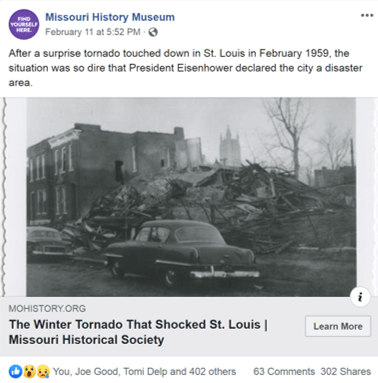
February 10th, 2020 was the 61st anniversary of a tornado that blew through downtown St. Louis. It tore through a few local landmarks, ripped walls off homes, and caused millions of dollars worth of damage. A few hundred people lost their lives and nearly a thousand became homeless overnight.

To mark the tragedy, I wrote up a blog post for the Missouri Historical Society’s (MHS) blog “History Happens Here” (https://mohistory.org/blog/). The next day, the Missouri History Museum (for those unfamiliar, it is one of the iterations of MHS) posted it on their Facebook site. I was super proud, since it was my first blog post published by any museum or historical institution, and as such, I kept a close eye on how it was doing – how many likes it got, it people commented or shared. Like many other MHS blog posts, I assumed it would get a handful of shares and garner a few stray comments. Man, was I surprised over the next two weeks.

Over that time, I was shocked to see it was shared a whopping 302 times, “reacted” to over 400 times, and commented on 63 times. When I wrote it, I certainly thought it was an interesting story, but I never would have imagined it would do so well. Of course, I would love to chock it up to my amazing writing skill and keen storytelling prowess, but setting my ego aside, I attribute the post’s success to the 1959 tornado’s placement in recent enough memory to be remembered.

(If you wish to feed my ego even further and give the page even more views, here’s the link 😉 – https://mohistory.org/blog/winter-tornado).

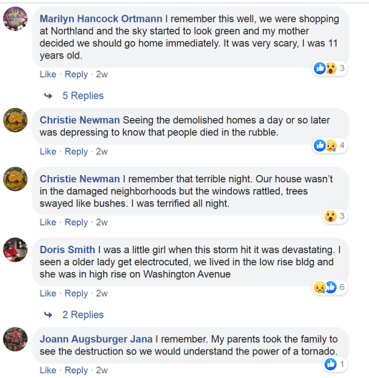
Disregarding a few comments from some real funny comedians who remarked that St. Louis today still looks like a disaster zone, the vast majority of comments are from people sharing their memories of the tornado. Very few people actually saw the funnel cloud since it touched down at 2 am on a Tuesday, but many people still living can recall driving around to see the destruction with their parents, hearing about it on the news, or even spending a scary night in their basement. One person even shared a photograph of the desolation outside their bedroom window!

Small sample of memory sharing via Facebook comment

The post really blew up on Facebook, but it did not make a splash of any kind on Twitter – it received maybe two retweets and a smattering of likes. If I had to conjecture why, I would guess that Facebook nowadays is more home to the older generation, that could remember the 1959 tornado, than the younger generations who maybe had never heard of it. On twitter, which more often plays host to the younger generations, this hit post performed about average for a MHS blog post, but it felt like a flop in comparison.

All this to say, when posting on social media, it is important to consider the audience you’re reaching out to and measure the success or failure of a post in comparison. What works for one medium might not work for another. This is not to discourage posting widely – you never know who it will reach.

Combining Place, Space, and Time through Deep Mapping

The essays collected in Deep Maps and Spatial Narratives, edited by David Bodenhamer, John Corrigan, and Trevor M. Harris play with the relationships between place, space, and time through the lens of a fairly new trend in humanities scholarship – the deep map. Before tackling this theoretical deep dive, I was not a complete stranger to the deep map.

My sophomore year as a student at Saint Louis University (#rollbills), I spent my spring semester studying abroad in Rome – eating amazing pasta, finding out how much gelato I could consume in one day, and traveling Europe sobbing with joy at historic sites and buildings. Shockingly to some (mostly my parents), I also went to class sometimes.

In one of my history classes, I was given a rather unconventional final project – instead of a paper, we were tasked with creating a deep map that told a story (of our choosing) about the history of Rome, connecting places with their dynamic stories across time.

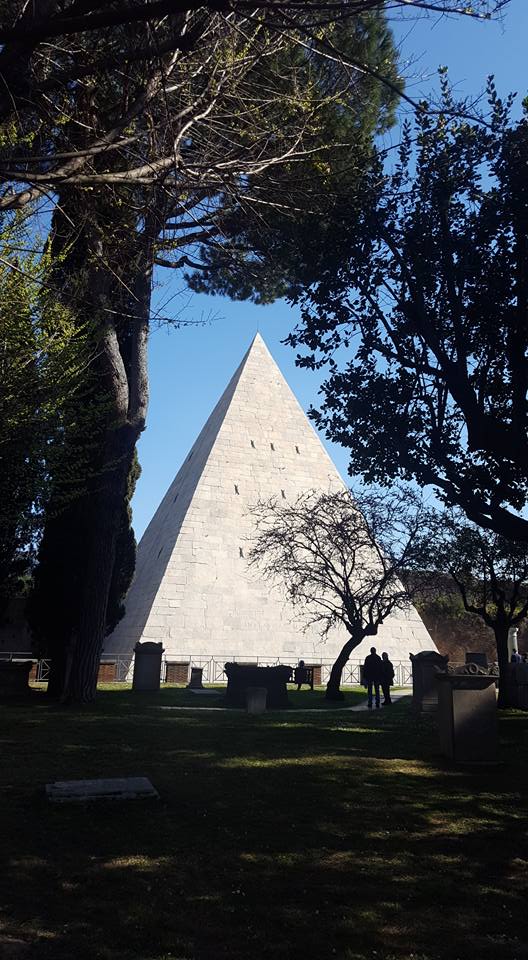
I chose to create a map that would tell the story of the Ancient Egyptian influence on Rome. This included everything from stolen obelisks that tower above tourists and the aggravated Romans avoiding them in a few of the city’s piazzas to a burial place for an Ancient Roman senator inspired by the pyramids of Giza and finally, a massive white marble obelisk emblazoned with fascist dictator Benito Mussolini’s name that still stands to this day.

The Pyramid of Cestius
View from the Protestant Cemetery
Rome, Italy
Taken by me

The Egyptian influences in Rome have more to do with than just simply aesthetics. They are symbols of the political obsession with supremacy, conquering, and grandeur. The Ancient Romans could point to their obelisks with pride to show that they had conquered the Egyptian corner of the world along with many others. The popes then shuffled the obelisks around the city, placing them in front of churches like St. Peter’s Basilica to show that they and the Church reigned supreme. Finally, Mussolini built his own modern obelisk to draw a straight, unbroken line between his power and the might of the Roman Empire. The fact that his name still stands tall next to the Tiber River also makes a powerful statement about Italy’s (and Europe’s) slow slide back into far-right politics.

My partner and I created our deep map using Prezi. At the time, I thought it was a fairly unsophisticated way to go about it, but it was the best we could do considering neither of us had any experience with (or access to) more complicated technologies like GIS. It was reassuring to see one of the collection’s authors, Trevor M. Harris, directly mention Prezi as a useful and valid tool for the task of creating a deep map.

With this brief foray into the world of deep maps in mind, I found it fascinating to hear from the experts in the field. I found Harris’s definition of deep mapping particularly illustrative:

To him, a deep map, “interweaves physical geography and scientific analysis with biography, folklore, narrative, text, memories, emotions, stories, oral histories, and so much more to contribute to a richer, deeper mapping of space and place” (39).

This quick definition expands the possibilities of a deep map much farther than I had imagined in my undergraduate class. It also opens up so many opportunities to turn a deep mapping project into a public history project that invites the general public to share their experiences of place and space over time. A deep map could also easily be incorporated into an exhibit or live within a museum’s digital presence.

These readings left me feeling not only nostalgic about my time abroad, but also inspired by the possibilities that deep maps represent.

Design a site like this with WordPress.com
Get started