Museum professionals and public historians are always looking to expand their audience. Social media, with its emphasis on connection, seems to promise institutions and researchers boundless opportunities to reach within their own community and beyond borders to share stories and invite people into the history-making process.
However, there is no magic formula that guarantees engagement with a post. Some topics that seem destined to interest Facebookers, Instagrammers, Tweeters, or even Snapchatters will flop. And on the flip side of the coin, some more “out-there” stories will grab the public’s attention and foment all kinds of discussions.
With three readings on social media as a foundation (“Managing social media, doing public history” by Max Farley, Krista Pollet, and Brian Whetsone [https://ncph.org/history-at-work/social-media-and-public-history/], “Doin’ it for the Gram: How Baltimore’s Chicory Revitalization Project uses Instagram to Engage the Public” by Sydney Johnson [https://ncph.org/history-at-work/doin-it-for-the-gram/], and “Technology, memory, and collective knowing” by Sarah Elwood and Katharyne Mitchell), I’ll dedicate this post to my personal experience with history and social media, and how the most seemingly random subjects can lead to public engagement and interest.
February 10th, 2020 was the 61st anniversary of a tornado that blew through downtown St. Louis. It tore through a few local landmarks, ripped walls off homes, and caused millions of dollars worth of damage. A few hundred people lost their lives and nearly a thousand became homeless overnight.
To mark the tragedy, I wrote up a blog post for the Missouri Historical Society’s (MHS) blog “History Happens Here” (https://mohistory.org/blog/). The next day, the Missouri History Museum (for those unfamiliar, it is one of the iterations of MHS) posted it on their Facebook site. I was super proud, since it was my first blog post published by any museum or historical institution, and as such, I kept a close eye on how it was doing – how many likes it got, it people commented or shared. Like many other MHS blog posts, I assumed it would get a handful of shares and garner a few stray comments. Man, was I surprised over the next two weeks.
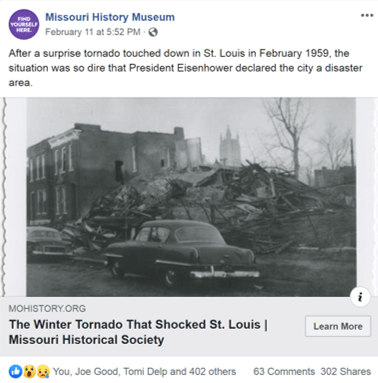
Over that time, I was shocked to see it was shared a whopping 302 times, “reacted” to over 400 times, and commented on 63 times. When I wrote it, I certainly thought it was an interesting story, but I never would have imagined it would do so well. Of course, I would love to chock it up to my amazing writing skill and keen storytelling prowess, but setting my ego aside, I attribute the post’s success to the 1959 tornado’s placement in recent enough memory to be remembered.
(If you wish to feed my ego even further and give the page even more views, here’s the link 😉 – https://mohistory.org/blog/winter-tornado).
Disregarding a few comments from some real funny comedians who remarked that St. Louis today still looks like a disaster zone, the vast majority of comments are from people sharing their memories of the tornado. Very few people actually saw the funnel cloud since it touched down at 2 am on a Tuesday, but many people still living can recall driving around to see the destruction with their parents, hearing about it on the news, or even spending a scary night in their basement. One person even shared a photograph of the desolation outside their bedroom window!
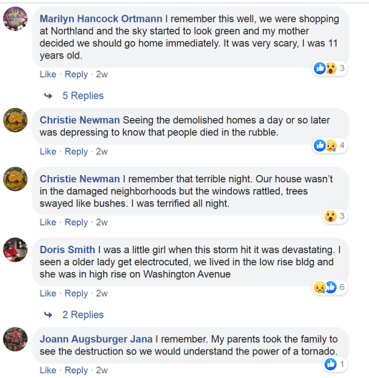
The post really blew up on Facebook, but it did not make a splash of any kind on Twitter – it received maybe two retweets and a smattering of likes. If I had to conjecture why, I would guess that Facebook nowadays is more home to the older generation, that could remember the 1959 tornado, than the younger generations who maybe had never heard of it. On twitter, which more often plays host to the younger generations, this hit post performed about average for a MHS blog post, but it felt like a flop in comparison.
All this to say, when posting on social media, it is important to consider the audience you’re reaching out to and measure the success or failure of a post in comparison. What works for one medium might not work for another. This is not to discourage posting widely – you never know who it will reach.
 MUSEUM MUSINGS
I agree that the demographic is likely different on Facebook: my parents have profiles there, but do not utilize any other social media. It is very neat that your post prompted further conversation and that people were able to contribute first-hand information! Readers could learn more about the event, and this would draw attention to the Missouri History Museum.
LikeLike