
Seth C. Bruggeman’s play by play account of the evolution of the George Washington Birthplace National Monument in Westmoreland County, Virginia is more than just an institutional history. Here, George Washington Was Born: Memory, Material Culture, and the Public History of a National Monument serves primarily as a reflection on the challenges that stem from contests over the collective memory, historical authority, and the ever-changing definition of authenticity. George Washington’s mythical status in American history makes him and the monument of his birthplace an excellent case study to dive into the tricky question of commemoration.
America’s first president only lived at his birthplace for the first three years of his life. Still, in the centuries since his birth, Americans of all ages have flocked, pilgrim-like, to the land enveloping the site where the Washington family home once stood. In addition, engaged citizens seeking to honor and preserve George Washington’s legacy have lined up to erect various commemorative landmarks on the site.
Most of the tension surrounding the interpretation of the birthplace arises from the sometimes conflicting goals and values of the two major entities involved in the site’s operation – the National Park Service (NPS) and the Wakefield National Memorial Association (Memorial Association). Where NPS historians were often most concerned with creating an authentic experience for visitors, reflecting Washington’s lived experience at the site, the ladies of the Memorial Association sought to advance their brand of patriotic collective memory and cement their version of George Washington’s heroic legacy. This specifically meant attributing Washington’s success and noble character to the well-run, healthy home of his mother Mary.
This mindset led to the creation of the Memorial House – an approximation of a typical 18th century colonial farm home placed on the site where Washington descendent George Washington Parke Custis placed the first memorial stone. Doubt cast on where the Washington’s home actually stood by a series of archaeological digs failed to sway the women of the Memorial Association. George Washington was perhaps the most celebrated figure in American history, so they wanted their Memorial House to be grand. After all, how could someone so courageous, noble, and diplomatic, come from a small, inauspiciously placed home like that built up on the newly discovered foundations of Building X?
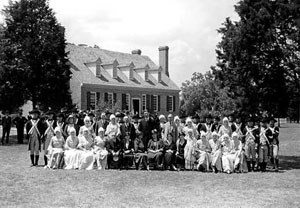
In my opinion, Bruggeman casts a far too sympathetic eye on the Memorial Association and their commitment to defending a romanticized version of Washington’s legacy throughout this book. At every turn, they seem to have purposefully ignored any evidence that complicated the narrative they wanted to tell. For example, they built a grand and inauthentic home to suit their idealized notions of George Washington and constantly tried to bury the existence of Building X. More than just creating a monument to Washington, they also created a monument to themselves. They slapped the names of donors onto nearly every available surface in the Memorial House and named their lodge after a former president.
Bruggeman attempts to paper over these shortcomings by stating that “the Memorial Association’s desire to honor itself was, in essence, a desire to write women back into a history so long crafted by men” (84.) I’m a huge proponent of telling women’s stories and incorporating them into the popular narrative of our history, but I’m not buying this explanation. If the Association had wanted to write women back into the story of George Washington, they could have centered the entire interpretation of the site around the day-to-day activities of Mary Washington. Thinking anachronistically, they could have even discussed the lives of the Black enslaved women who nurtured Washington in his first years of life.
Instead, I think their Memorial House served more as a shrine to Washington’s upper-class would-be aristocratic upbringing. By placing their names all over the house, the ladies of the Memorial Association were cementing their place alongside Washington in the American aristocracy.
If I had any say in the future direction of the George Washington National Birthplace Monument, I would advocate for the removal of the Memorial House entirely. In light of the announcement of President Trump’s toxically nationalistic 1776 Commission, I think it’s more important than ever that we look at our founding fathers as authentically as possible. Personally, I believe that other sites, like Mount Vernon, held much more significance to Washington the man. So why not shift the focus of the site at least partially to the plantation system and enslavement?
In our current moment, it seems like visitors would be willing to engage with difficult histories. Going forward as museum professionals, it’s our job to address modern issues in meaningful ways by looking back to the challenges of the past. Bruggeman’s book provides a detailed look at the challenges that lie ahead when you pit memory against authenticity. With the future of our country at stake, these challenges are incredibly worthwhile.
 MUSEUM MUSINGS
The addition of exhibits at popular historic sites dealing with historic questions never before covered is definitely a worthwhile project. It even stands a chance of bringing new publicity to museums and sites that are lagging.
LikeLike