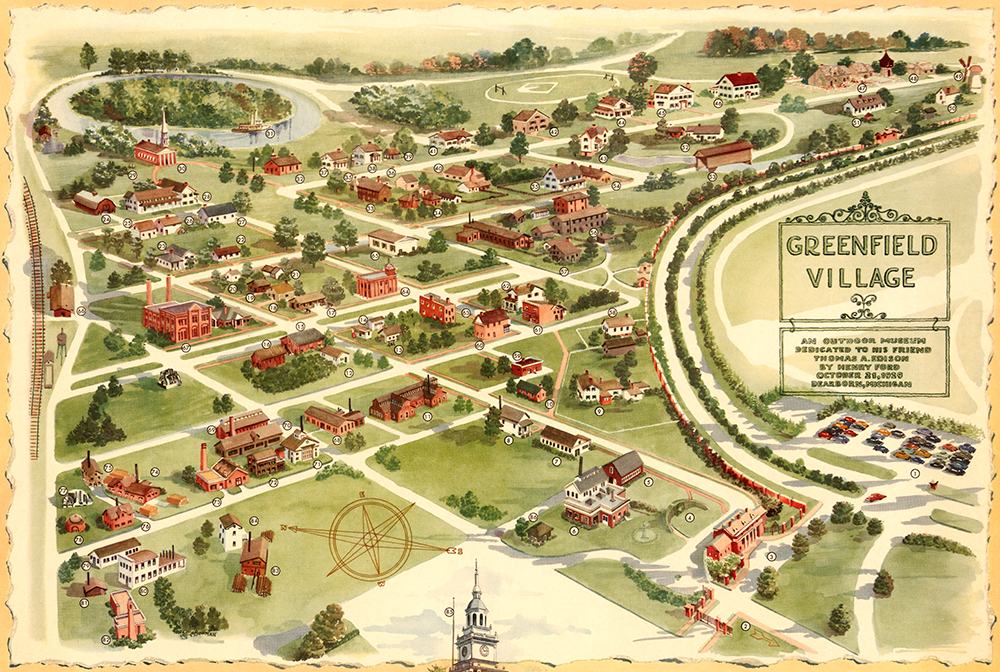
Henry Ford, a man of immense means and influence, had the funds, resources, and connections to recast history and display his values and ideals. The end result was Greenfield Village – idealized Small Town, USA populated by inventors, innovators, and entrepreneurs who trumpet old-fashioned values – and its accompanying museum of technological development. The history of this institution is explored in Jessie Swigger’s book “History is Bunk”: Assembling the Past at Henry Ford’s Greenfield Village.
Ford intended to throw a wrench in “traditional” history with its focus on political maneuvering and shifting fronts in battle by highlighting everyday experiences of men in the landscape he grew up in and cherished. However, as time went on, Greenfield Village grew into an amalgam of restored and recreated buildings from various time periods and locations, divorced from their original context and occasionally warped to fit Ford’s vision. In the years after Henry Ford’s death, the increasingly professionalized staff at Greenfield Village have struggled to create a comprehensive and authentic visitor experience, deal with racially sensitive topics, and connect with communities in the urban environment of Detroit (which founder Henry Ford and local Dearborn residents so hated.)
Despite Greenfield Village’s flaws, missed opportunities, and mistakes, Swigger argues that the idea behind Greenfield Village is truly revolutionary. To her, the shops and homes that make up the Village serve as an “animated textbook” (2) that privileges physical objects over the written documents favored in “traditional” history. Throughout the book, Swigger compares Greenfield Village to similar sites like Colonial Williamsburg in Virginia and Old Sturbridge Village in Massachusetts while extoling their virtues as places where visitors can make a tangible connection to the past.
In my opinion, Greenfield Village is a much better idea in theory than in practice. Henry Ford was clearly the visionary behind the site and the supreme authority in decision making. From my reading of the book (sometimes between the lines), it seems like Ford created a mishmash of loosely connected sites that had little to no bearing on the ground they were now placed on and were robbed of any associated stories that Ford did not like. In the years after his death, staff members were forced to walk a fine line between righting the ship to transform the site into a place of meaning and honoring Ford’s memory and vision.
I see this study of Greenfield Village as a manual of what not to do for the museum and public history fields at large, urging professionals to learn from the mistakes of the past. For me, it goes back to Nina Simon’s question in The Art of Relevance (paraphrased here): If you had to pack up in the middle of the night, would your community take you in? Personally, I don’t think Dearborn and Detroit, Michigan, would. This book, for me, reinforced the importance of grounding stories locally, consulting multiple perspectives, and creating relationships with the communities you want to serve – all things Greenfield Village historically has not done.
 MUSEUM MUSINGS
The progress the Henry Ford has made since 1981 can be attributed, to a degree, to the decisions made by a changing administration. To a larger degree, however, it can be attributed to the vast funds that enabled the Museum to stay in business for decades. A smaller history museum, unattached to a famous brand like Ford, could not afford to create such an idiosyncratic depiction of history and risk losing their audience.
LikeLike
Calling this “a manual of what not to do for the museum and public history fields at large” was my largest takeaway as well. However, like Jim said, the museum did end up redeeming itself in the face of its rocky and controversial past. If anything, the Ford Museum is a perfect example of how to come *back* from being an institution with infamy.
LikeLiked by 1 person
Your point is absolutely fair and well taken, but I am not entirely convinced that Greenfield Village and the Henry Ford Museum have fully come back. I think they still have a ways to go in terms of walking the line between education and entertainment. Personally, in its current state, I don’t think I would visit.
LikeLike
i really appreciate the craft you bring to your posts, lindsay. great image!
LikeLike